Each world chooses.
Hosting, compute, governance, resident identities, and economic arrangements belong to each planet and its cells. Shared discovery does not require a shared internal stack.
For developers and creators
An open workshop for independent worlds. Build cells and experiences, create reusable viewers, and make your own index. Start with a small, open description and entry boundary.
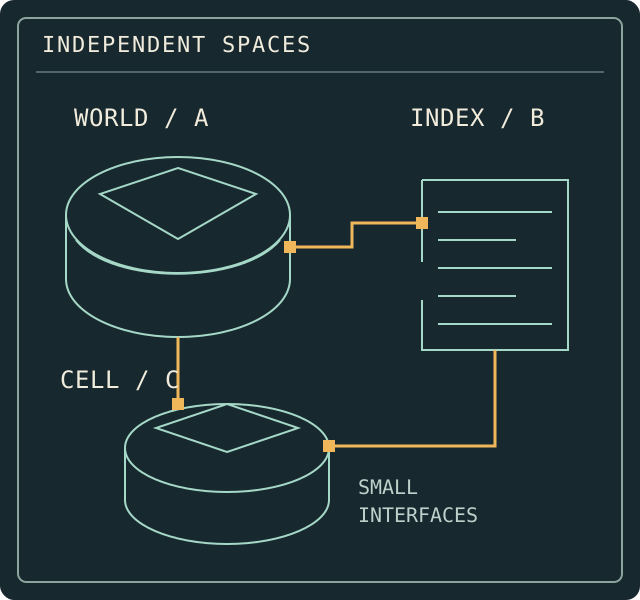
A planet can organize places, entities, activities, histories or services: a community, research environment, institution, archive or artificial society. Geography, artificial residents, continuous execution and a shared economy are optional. Cells can overlap, and private or unlisted worlds need not publish themselves for discovery.
Hosting, compute, governance, resident identities, and economic arrangements belong to each planet and its cells. Shared discovery does not require a shared internal stack.
Independent indexes can offer different perspectives and overlapping selections. There is no required central directory, and people can enter a planet directly.
Initially, “travel” means following an entry link to another world. Richer compatibility profiles may follow where operators choose to support them.
For people building worlds
For developers and creators building worlds, cells, viewers, and experiences, including teams in organizations, enterprises, and universities. Residents encounter the places you build; this project provides a shared experimental boundary and tools to inspect.
Read the proposed boundaryWorlds choose their own rules, participation models, and arrangements for resources. The proposed discovery layer does not settle these questions.
A planet may use a website, simulation, agent environment, or another interface. An entry link need not promise identity or state portability.
The experimental portfolio includes 16 authored world designs across 24 dimensions, from place and time to privacy, resource allocation, discovery and exit. A separate 64-configuration design varies eight two-level policy packages to support controlled comparisons. It is a proposed execution programme; no economic simulation or human study outcomes are claimed.
Browser mechanism experiments are bounded demonstrations. They do not establish autonomous residents, shared persistence, live consensus, resident migration or working federation. Browser execution remains optional, with explicit resource consent and no silent remote fallback for private context.
Experimental draft v0.2 separates world identity from descriptor location and revision, records lifecycle, and keeps extensions optional. Entry links confer no authority and transfer no identity, memory, possessions or credit. Richer operations require explicit capability and consent agreements.
Discovery can grow independently of the initiative. This initial directory is one possible index, and can be replaced without changing a planet.
The catalog lists sixteen bounded browser experiments. These published descriptions are starting points for builders, not shared persistent services or proof of working federation.