Building Doors and Opening Worlds
I'm a systems engineer. I'm always taking a step back, and thinking about the bigger picture. If I'm working on a space mission, I want to think about where the space mission is going, and the context in which the program is being executed.
So, when I'm turned my focus more intently toward building artificial people, I recognized that they need a actual space to inhabit, and to travel, and mingle, etc. I had to step back. Well, I could have stepped back to globular clusters, or galaxies, or the universe, or the multiverse, but I figured, when I was building artificial people, the solar system was zoomed out back enough.
Why a solar system? Because there is a lot of variety to cover. Since Essex university made the "Multi User Dungeon" in 1978, there have been many shared online worlds. I like building general-purpose tools. But when I make choices in what I build, I want to preserve freedom for those that reuse what I build. I hate closing a door just because I'm making a decision, and I have empathy for other developers or users or use cases which would benefit from the other roads that I am not taking.
One world, and one way to set up a world, was never going to work for everybody.
And also, I want to build lots of experiences with different kinds of artificial people. Take two competing priorities: I want to deploy minimal friction applications to nontechnical people, and I also want to share free and open source software for technically capable persons to control and self-host. These are two very different users, and two very different use cases! It's hard to serve both by the same product!
How can I facilitate those who self host to network their worlds and AIs together, while also enabling non technical people to use these systems without friction or closing off alternatives?
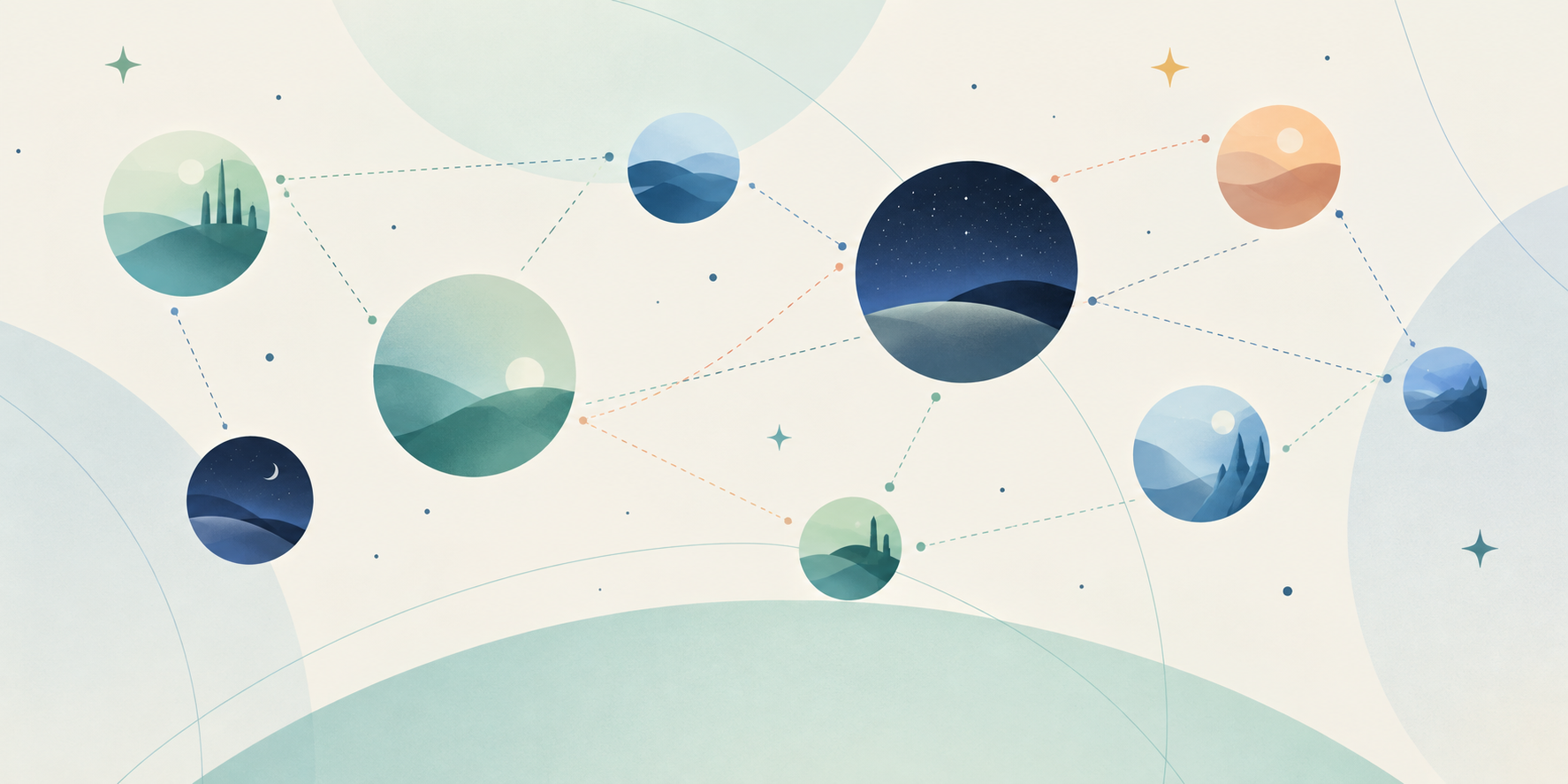
I need reusable and optional components which can be combined in different ways. Different worlds that play by different rules. And if we back up all the way, a registry or catalog of worlds, or better yet, a method to catalog worlds that anyone can follow. App stores, online ecommerce sites, social feeds, they use algorithms that are designed to engage and extract. curation is useful, so long as it stops before censorship and control! Bluesky allows you to choose your algorithm. I want users to choose their bluesky.
Podcasts, before a recent shift toward corporate, was more weird and wild, where discovery was organic and chaotic. This changes when your podcast player is also the content creator and the index.
Cyberplanetary builds free and open source catalog protocol, so anyone can subscribe to whichever world catalogs they like. Cyberplanetary builds and publishes ways to coordinate the simulation and generation of worlds and world state. These are primatives which are necessary for flourishing of human choice of the experiences that we want to experience.
I dont want to create a central catalog. I want to create a way to catalog, and demonstrate and enable users and developers to build catalogs, and use catalogs.
Drop me a line at john@cyberplanetary.org with your thoughts!
John Benac Founder, Cyberplanetary